

“The stock exchange is at once the fairest and most deceitful business in Europe, the noblest and most infamous in the world, the finest and most vulgar on earth. It is a quintessence of academic learning and a parade of fraudulence; a touchstone for the intelligent and a tombstone for the audacious; a treasury of usefulness and a source of disaster.”
-Joseph de la Vega, Confusion of Confusions, 1688
In the Middle Ages, hundreds of cogs plied Europe’s North Sea, laden with grain, timber, salt, and fish. To fund the fleet, merchants, captains, and other elites bought into “ship shares,” which were ship-specific companies that shared in the risks inherent in oceangoing as well as the rewards. The Dutch, in particular, did this at an unprecedented scale.
The land-dwelling investors were students of the sea. They studied trade routes, developed governance structures, and built relationships with shipwrights, merchant guilds, crews, and captains. Though the vicissitudes of the weather, war, and pirates were beyond their control, they were obsessed with better understanding the uncertain waters upon which they were setting their wealth.
By the late 16th century, their diligence and success at trade had brought Holland into a golden age. This rise led to conflict with Europe’s other great powers. When the Dutch lost access to Lisbon’s spice markets, prices surged.
Three wealthy merchants saw opportunity and considered an epic risk: an expedition beyond the map funded not by a government but with their own capital. Immense research went into the undertaking. They studied maps and trade reports, sent a spy (Cornelis de Houtman) to Lisbon to confirm their intelligence, and planned extensively for the contingencies of such a voyage, including the very real prospect that much of the leadership would die at sea. Convinced that the return was worth the risk, they gave the venture a name: “Compagnie van Verre.” The Far Distance Company.
When almost two hundred fifty men left Amsterdam in 1595 aboard four cramped ships backed by nine merchants (the original three had recruited six more), they were led not by an admiral but by a council headed by de Houtman, a merchant.
The difficulties of the journey were immense. Rude maps of the Indian Ocean had reached the Netherlands less than a decade before and were anything but precise. Scurvy broke out almost immediately. On one stop in Madagascar, fully a third of the men were buried. Pirates attacked. A captain was imprisoned in his own cabin for the remainder of the voyage after a particularly intense quarrel. It would be two and a half years before the fleet limped back to harbor with three ships, a hundred survivors too weak to moor the boats themselves, and two hundred forty-five tons of pepper. The Far Distance Company broke even, but only just. The natives, smelling desperation, had sold to it at above market prices.
Despite the immense human toll and lack of wealth generation, the voyage proved the thesis and emboldened its backers. Subsequent ventures fared better (one returned with six hundred tons of pepper, generating a 400% return), but the repeat investors quickly realized the inefficiencies inherent in the voyage-by-voyage model. By 1602, less than a decade after de Houtman first sailed, the merchants banded together to found the Dutch East India Company (VOC). As de la Vega put it eighty years later: “Gradually the company developed to such an extent that it surpassed the most brilliant enterprises which have ever been famous in the history of the world.” The atrocities visited upon the peoples it traded did not factor into his panegyric.
By all financial and operational measures, the VOC was a huge success, which created a new problem: as a permanent venture with unprecedented scale and with long windows between fleets, it paid no dividends for years at a time. Shareholders had to be wealthy enough to stomach years of illiquidity, and this inconvenience made the shares themselves less attractive.
The Amsterdam Beurs was established as the world’s first modern stock exchange to solve this issue. It worked famously. With VOC shares freely tradable and ownership democratized, the arrival of fleets from the East became civilizational events on par with Rome’s triumphs. Liquidity had enormous benefits, lowering the cost of funding the company and allowing many more citizens to participate in its success, but it also enabled other behaviors. A trader could now profit from a voyage without waiting for the fleet to arrive, distancing them from the actual success or failure of the venture.
Within decades the exchange became a den of financial adventurism that de la Vega called “a confusion of confusions.” Derivatives, pump-and-dump schemes and rumor-mongering proliferated. During the long months between news, the expeditions were abstractions and profit depended on predicting the appetites of future buyers or getting ahead of the next report. Enterprising traders reputedly engaged fast boats to “front-run” the fleet, racing word of its fate back to the exchange to profit at the expense of the uninformed.
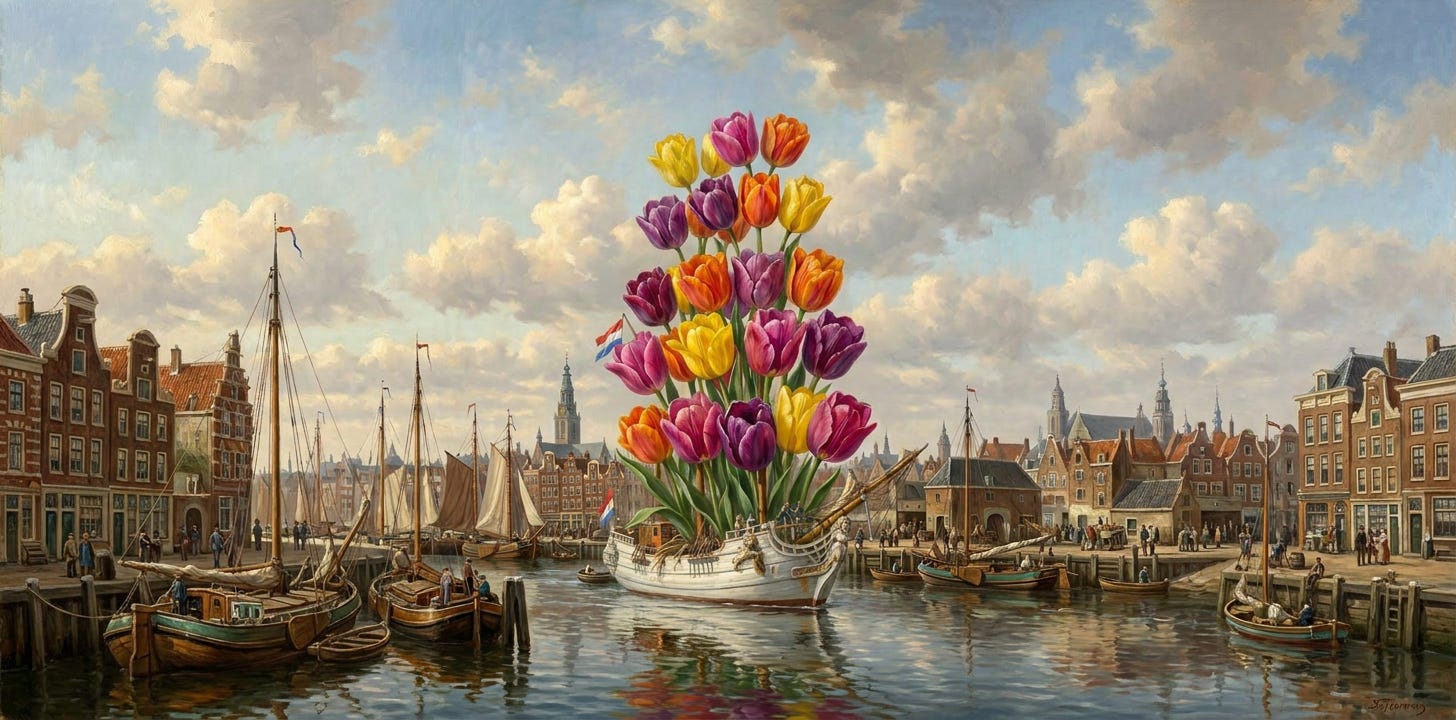
As wealth and colonial fervor grew with each arrival of silk, spice and exotica from the East, tulips rose to popularity in Holland. The same transportability that had helped them spread across Europe meant they could be bought and sold seasonally with ease.
Trade in bulbs soon provided bored merchants with a winter pastime. Financial concepts born of the stock exchange migrated into the floral domain, and intrepid traders began writing futures contracts. Convenient year-round trading was the selling point, but the move from bulbs physically changing hands to paper swaps transformed grounded collectibles into objects of speculation. Prices shot skyward; word spread of wealth to be made. The primal human instinct to move to where the hunting seems best was activated at scale. Bulbs traded for 10x the annual salary of a master craftsman. Fortunes grew and were predictably blighted by the now-famous crash that came in February 1637.
In just four decades, techniques born of ship shares had drifted into something unrecognizable to the staid merchant class who funded them. As de la Vega put it:
“Gamblers and speculators… have tried to decide all by themselves about the magnitude of their gains and, in order to do so, they have put up wheels of fortune. Oh, what double-dealers! Oh, what an order of life has been created by these schemers!”
The logic that fostered the emergence of the tulip mania was coherent. The flower-traders considered their activity consistent with the behavior of stock traders on the bourse, who grasped for tidbits of information about far-flung fleets. The stock traders felt akin to the capitalists who had funded fantastic voyages one by one: after all, both exposed their fortunes to the vagaries of the weather and commodity prices. The original merchants who funded de Houtman saw their effort as a natural extension of the ship shares: the same basic risks, taken to an “off the map” extreme with the promise of attendant rewards.
This raised a question which vexed de la Vega. Doubtless, the men at sea were engaged in acts of skill and bravery, but all of the participants on land risked only money. None of them were manning the rigging or braving scurvy. So what separated the merchants who funded de Houtman from the day traders of VOC shares and tulip bulbs?
De la Vega provided the seed of an answer in his distinction between the mentality of the wealthiest in Amsterdam and that of the climbing class:
“Every year the financial lords and the big capitalists enjoy the dividends from the shares that they have inherited or have bought with money of their own. They do not care about movements in the price of the stock. Since their interest lies not in the sale of the stock but in the revenues secured through the dividends, the higher value of the shares forms only an imaginary enjoyment for them.”
His comparison bleeds the ubiquitous inequality of the era, but the distinction holds even if it was driven by privilege: one takes on the role of the investor and escapes the role of gambler by owning shares that one expects or at least is willing to own forever, such that the actual success or failure of the venture, not the whims of other investors, drives the outcome. The backers of the Far Distance Company, lacking anyone to sell their fleet shares to, demonstrated this mindset regardless of their wealth or the risks they took. They identified and recruited top talent, pored over maps to find the best trade routes, engaged in corporate espionage and stress-tested governance structures. Their willingness to risk their capital on a specific endeavor was itself a contribution to human progress, and their diligence was inextricably related to the telos of the voyage itself.
The trading and arbitrage-seeking behaviors that spring up around liquid financial markets are not so tied. When gardenless buyers of tulip bulbs succumb to mania, they bend the benefits of liquidity into behavior that has nothing to do with the true merits of the bulbs themselves. When markets make detachment easy, the ownership mindset becomes fragile. Yet it is precisely that ethos — the implicit willingness to tie one’s fortunes to the actual success of an enterprise and the intense, farsighted diligence that comes with it — that separates investing from speculation.